

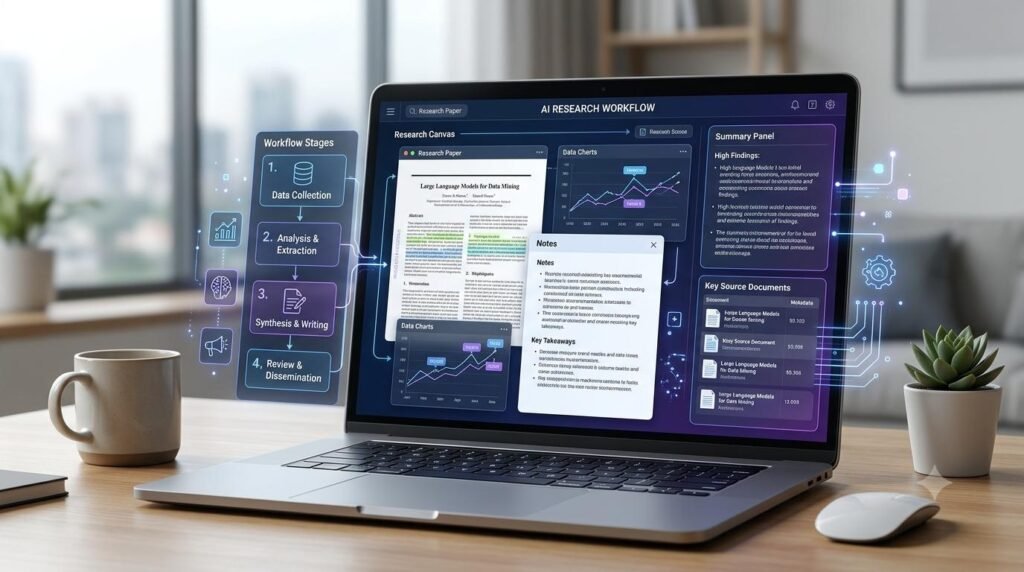
An AI research workflow helps you find information, evaluate sources, organize findings, and make better-informed decisions. Instead of collecting information randomly, you can follow a repeatable process that uses AI to support research while keeping accuracy and critical thinking at the center.
Whether you are a blogger, student, creator, freelancer, or business owner, research can take considerable time. AI tools can help you generate search questions, summarize documents, compare information, and organize key points. However, AI-generated answers should always be checked against reliable sources.
In this guide, you will learn how to build an AI research workflow in seven practical steps.
Table of Contents
ToggleWhat Is an AI Research Workflow?
An AI research workflow is a structured process for finding, reviewing, analyzing, and summarizing information with the assistance of artificial intelligence.
A simple workflow follows these stages:
Search → Analyze → Summarize → Verify → Decide
For example, a content creator researching a new topic might begin by identifying the main question, search for trustworthy sources, compare the evidence, summarize important findings, and use the results to plan an article.
The purpose is not to let AI make every decision. It is to organize research more efficiently and help you understand the available evidence.
Why Use AI for Research?
AI can assist with several research activities when used carefully.
Research planning: Turn a broad topic into specific questions.
Search preparation: Generate relevant search terms and related concepts.
Information organization: Arrange notes under useful headings.
Document summaries: Extract key points from material you provide.
Comparison: Identify similarities and differences between sources.
Decision support: Organize evidence, limitations, and unanswered questions.
AI can also produce inaccurate information, misinterpret sources, or present unsupported statements confidently. Always verify important facts and retain the original source links.
Step 1: Define Your Research Question
Start by deciding exactly what you need to learn. A broad topic can lead to too much information, while a focused question helps you research more efficiently.
For example, instead of researching “AI tools,” you might ask, “Which AI tools can help a small business draft customer emails while allowing a person to review every message?”
A useful research question should identify the subject, the information you need, and the purpose of the research.
AI prompt for research planning
Help me turn this topic into a clear research question. Suggest five specific subquestions, identify the types of evidence I should look for, and list important limitations to consider. Do not provide unsupported factual claims. Topic: [insert topic]. Research goal: [insert goal].
Your output: A focused research question and a list of subquestions.
Step 2: Search for Relevant Sources
Once your question is clear, find sources that can help answer it. Depending on the topic, useful sources may include official documentation, government publications, academic papers, reputable industry reports, and primary sources.
AI can help generate search terms and identify concepts you may have overlooked. If an AI tool provides citations or source links, open the original pages to confirm that they exist and support the claims being made.
Try using different search terms rather than relying on one query. For current topics, check publication dates and whether the information has been updated.
AI prompt for search preparation
Based on this research question, suggest ten search queries that could help me find relevant and reliable sources. Include alternative wording and specific terms I should investigate. Do not invent URLs, citations, or research findings. Research question: [insert question].
Your output: A search plan with useful queries and source types.
Step 3: Evaluate Source Reliability
Not every search result deserves equal trust. Before using a source, consider who created it, what evidence it provides, when it was published, and whether other credible sources support its claims.
Use this checklist:
Authority: Is the author or organization qualified to discuss the topic?
Evidence: Are claims supported by data, references, examples, or original research?
Currency: Is the information recent enough for your purpose?
Purpose: Is the source informing, selling, persuading, or entertaining?
Corroboration: Do other independent, reliable sources support the main claim?
AI can help organize a source review, but it cannot replace your own verification. A polished summary does not automatically make the underlying information reliable.
Your output: A shortlist of sources worth examining in detail.
Step 4: Analyze and Compare the Information
After collecting sources, look for patterns, differences, evidence gaps, and competing explanations.
You can use AI to organize the information into a comparison table. Provide the source text or notes and ask the tool to distinguish directly supported facts from interpretations and unanswered questions.
AI prompt for analysis
Analyze the research notes below. Organize the main claims, supporting evidence, differences between sources, limitations, and unanswered questions in a table. Do not add facts that are not present in the notes. If two sources disagree, show the disagreement instead of choosing a winner without evidence. Research notes: [insert notes].
Review the output against the original material. Check whether important qualifications have been lost and whether the sources actually support the conclusions.
Your output: An evidence-based comparison of the available information.
Step 5: Summarize the Key Findings
A useful research summary communicates the most important findings without overwhelming the reader with details.
Organize your summary into four parts:
Main findings: What does the available evidence indicate?
Supporting evidence: Which sources support those findings?
Limitations: What is uncertain, incomplete, or disputed?
Next questions: What additional research may be needed?
AI prompt for summarizing research
Summarize the research notes into clear sections covering the main findings, supporting evidence, limitations, and open questions. Preserve important qualifications and do not introduce unsupported facts. Keep source references attached to the claims they support. Notes: [insert verified notes and source details].
Use the summary as a working document, not as proof that every statement is correct. Recheck important claims in their original sources before publishing or relying on them.
Your output: A concise research summary with traceable sources.
Step 6: Verify Important Claims
Verification is essential in any AI research workflow. AI tools may misquote a source, overlook a date, confuse two concepts, or produce a citation that does not support the statement.
Before using your findings, check:
Whether each important claim appears in the cited source.
Whether names, dates, statistics, and quotations are accurate.
Whether the source is appropriate for the claim.
Whether the information is current enough.
Whether important context or uncertainty has been omitted.
Whether independent sources support significant conclusions.
For sensitive, technical, legal, financial, or health-related topics, consult appropriate authoritative sources and qualified professionals where necessary.
Your output: A verified set of findings ready for responsible use.
Step 7: Turn Your Findings Into a Decision or Deliverable
Research is most useful when it supports a clear next step. Depending on your goal, the result might be an article outline, a business comparison, a project plan, a presentation, or a list of options for further investigation.
Separate what the evidence shows from what you recommend doing. If information is incomplete, state the uncertainty and identify what additional evidence could change the conclusion.
AI prompt for decision support
Based only on the verified findings below, outline the available options, the evidence supporting each option, the main risks, and the information still missing. Do not make unsupported assumptions. End with practical next steps and explain what should be checked before making a final decision. Findings: [insert verified findings]. Goal: [insert goal].
Your output: A clear deliverable or decision framework based on verified research.
Example: Researching an AI Tool for Content Creation
Imagine that a blogger wants to evaluate an AI tool for helping with content research.
| Stage | Example task | Output |
|---|---|---|
| Search | Find official product information and independent reviews | Source list |
| Analyze | Compare features, limitations, and pricing information | Comparison notes |
| Summarize | Organize the key benefits and drawbacks | Research summary |
| Verify | Check claims against original sources | Verified findings |
| Decide | Assess whether the tool fits the blogger’s needs | Evaluation and next steps |
Common AI Research Workflow Mistakes to Avoid
Trusting AI-generated citations without checking them
Open the original source and confirm that it exists and supports the relevant claim.
Using only one source
A single source may be incomplete, outdated, or biased. Look for independent corroboration where appropriate.
Confusing summaries with evidence
A summary is only as reliable as the source material and the process used to create it. Keep the original references available.
Ignoring conflicting information
When sources disagree, document the disagreement and investigate why. Do not hide uncertainty simply to produce a neat conclusion.
Collecting information without a clear goal
Define your research question before searching. Otherwise, you may spend time gathering details that do not help answer the main question.
Sharing sensitive information carelessly
Use appropriate privacy safeguards when working with documents, customer records, internal business material, or other confidential information.
Frequently Asked Questions
What is an AI research workflow?
An AI research workflow is a repeatable process for searching, evaluating, analyzing, and summarizing information with AI assistance while verifying important claims against reliable sources.
Can AI do research automatically?
Some tools can assist with multi-step research and produce summaries with citations. Their results still require review because sources may be incomplete, claims may be misinterpreted, and citations may not support every statement.
How can I check AI research for accuracy?
Open the original sources, verify important claims, check dates and statistics, compare independent evidence, and record uncertainty where the evidence is incomplete or conflicting.
Which tasks can AI help with during research?
AI can help plan research questions, suggest search terms, organize notes, summarize supplied documents, compare sources, and structure findings. Its usefulness depends on the task, source quality, and verification process.
Is an AI research workflow useful for content creators?
Yes. Content creators can use it to plan article research, organize reference material, compare information, and prepare outlines. They should verify factual claims and cite sources appropriately before publishing.
Recommended Digital Resources
Explore useful digital resources that can support your research, content planning, and online business activities. Find practical products to help you organize your work and develop your digital skills.
Need a Free Tool?
Use free online tools and utilities to help with everyday digital tasks, calculations, and content preparation. Explore the available tools and choose what fits your workflow.
Final Thoughts
An AI research workflow gives you a structured way to move from a question to useful, verified findings. By defining your goal, searching carefully, evaluating sources, analyzing evidence, summarizing results, and checking important claims, you can make research more organized and productive.
Start with one research task and improve the process as you learn what works. Use AI to support your thinking—not to replace source verification, critical judgment, or responsibility for the final decision.
Related Guides
Explore more practical guides to learn, work, and grow with AI.

AI Content Creation Workflow
Learn how to build an AI content creation workflow to research ideas, write engaging content, optimize for SEO, and publish efficiently.

AI Business Workflow
Discover how to use an AI business workflow to organize leads, draft emails, manage follow-ups, and streamline daily business tasks.

AI Workflow for Beginners
Learn how to organize everyday tasks and build a practical workflow with AI.